

Professional One-Stop Eyewear OEM/ODM Solution from Concept to Mass Production
As a professional eyewear manufacturer in Wenzhou, China, we provide a complete OEM and ODM eyewear manufacturing solution covering product development, material selection, engineering, sampling, production, quality control, packaging, and international delivery.
Whether you already have your own design, drawings, reference samples, or only a product concept, our production team can coordinate the entire process from the initial idea to finished eyewear.
Our objective is not simply to manufacture frames. We help customers build commercially viable, production-ready eyewear collections with controlled quality, competitive costs, stable lead times, and flexible customization.
The first stage is to understand the customer's business requirements and establish a clear project specification.
Customers can provide:
● Existing eyewear samples
● Product drawings
● CAD files
● Product photographs
● Sketches
● Reference products
● Pantone colors
● Material requirements
● Target price
● Target market
● Expected order quantity
● Packaging requirements
● Brand guidelines
● Logo files
● Lens requirements
For customers without a finished design, our team can also discuss the intended:
- Frame shape
- Target consumer group
- Gender positioning
- Material
- Color direction
- Size
- Functional requirements
- Price positioning
- Market style
Project information is then organized into a preliminary specification sheet.
Typical information includes:
|
Item |
Requirement |
|
Product Type |
Optical Frame / Sunglasses |
|
Development Type |
OEM / ODM |
|
Material |
Acetate / Metal / TR90 / PC, etc. |
|
Target Market |
Europe / USA / Middle East / Other |
|
Frame Shape |
Square / Round / Cat-eye / Aviator, etc. |
|
Size |
Customized |
|
Lens |
Optical / Sunglasses / Polarized / UV |
|
Color |
Custom / Standard |
|
Logo |
Printing / Engraving / Metal Logo |
|
Packaging |
Custom Box Set |
|
Estimated MOQ |
Project dependent |
|
Target Price |
Customer target |
|
Delivery Requirement |
Negotiated |
Purpose: eliminate misunderstandings before entering the development stage.
After receiving the requirements, the project is classified as OEM or ODM.
OEM - Original Equipment Manufacturing
OEM is suitable when the customer already has a specific product concept or design.
The customer may provide:
- Existing sample
- CAD drawing
- Technical drawing
- Product dimensions
- Logo
- Color specification
- Packaging design
The factory converts the customer's specifications into a manufacturable product.
Typical OEM process:
Customer Design → Engineering Review → Sampling → Customer Approval → Mass Production
OEM is particularly suitable for:
- Established eyewear brands
- Optical retailers
- Distributors
- Private-label brands
- Importers
- Corporate purchasing projects
ODM - Original Design Manufacturing
ODM is suitable for customers who need assistance with product development.
The factory can participate in:
- Shape development
- Material selection
- Color development
- Structural optimization
- Hardware selection
- Acetate pattern selection
- Product engineering
- Sample development
- Packaging recommendations
The customer selects or modifies a suitable design before production.
Typical ODM process:
Market Direction → Design Concept → Product Development → Prototype → Sample → Approval → Mass Production
ODM is especially useful for new brands and buyers who want to develop differentiated eyewear collections without building their own manufacturing infrastructure.
Once the project direction is confirmed, the product enters the design and engineering stage.
For acetate eyewear, particular attention is paid to:
- Front frame geometry
- Lens shape
- Bridge construction
- Temple thickness
- End-piece structure
- Hinge position
- Temple curvature
- Nose fit
- Frame balance
- Weight distribution
- Material thickness
- Decorative details
The objective is to balance appearance, comfort, durability, and manufacturability.
A design may look attractive on a computer or reference sample but still be difficult or expensive to manufacture. Therefore, our engineering team evaluates whether the design can be converted into a stable production process.
Engineering review normally considers:
Design → Material → Tooling → Processing → Assembly → QC → Cost
This prevents expensive modifications after mass production begins.
Material selection has a direct impact on appearance, durability, comfort, cost, and production efficiency.
For acetate eyewear, customers can select different grades, thicknesses, and color structures according to the target product positioning.
Common material options include:
- Acetate
- Metal
- TR90
- PC
- Acrylic(CP)
- Mixed-material construction
For premium acetate products, material evaluation may include:
- Thickness
- Density
- Surface finish
- Color consistency
- Transparency
- Pattern distribution
- Lamination quality
- Flexibility
- Processing suitability
Acetate color development
Customers can select:
- Solid colors
- Transparent colors
- Tortoiseshell
- Marble patterns
- Gradient patterns
- Multi-layer laminations
- Custom color combinations
For private-label brands, exclusive color development can be used to create a more differentiated collection.
Before tooling or production begins, the product specifications are converted into technical information.
Important dimensions may include:
- Lens width
- Bridge width
- Temple length
- Frame width
- Front height
- Lens height
- End-piece dimensions
- Temple thickness
- Hinge position
For example:
52-18-140
Normally represents:
- 52 mm lens width
- 18 mm bridge width
- 140 mm temple length
Additional engineering details can include:
- Hinge specification
- Screw specification
- Nose pad structure
- Temple core
- Logo position
- Decorative components
- Lens groove
- Bevel structure
- Frame thickness
The technical specification becomes the foundation for subsequent sampling and mass production.
After the design and specifications are confirmed, the factory starts prototype development.
Depending on the product structure, this may involve:
- Material preparation
- CNC cutting or pattern processing
- Component preparation
- Frame shaping
- Hinge installation
- Temple processing
- Surface finishing
- Assembly
- Preliminary inspection
For acetate frames, production may involve precision CNC cutting combined with manual finishing and polishing.
The first sample is not simply a sales sample. It is also an important engineering verification stage.
After the prototype is completed, the sample is inspected internally before being sent to the customer.
The factory checks:
Appearance
- Color
- Pattern
- Transparency
- Surface finish
- Polishing
- Decorative details
- Logo position
01
Structure
- Frame symmetry
- Temple alignment
- Hinge operation
- Bridge structure
- Lens groove
- Temple curvature
02
Dimensions
- Frame width
- Lens size
- Bridge size
- Temple length
- Overall dimensions
03
Wearing performance
- Opening and closing
- Frame balance
- Temple pressure
- General fitting
- Stability
04
The customer then evaluates the sample.
Possible outcomes:
Approved → Production Preparation or Revision Required → Engineering Modification → New Sample
For professional OEM/ODM projects, one sample is not always the final sample.
Customer feedback may involve:
- Frame too thick
- Frame too heavy
- Color needs adjustment
- Temple needs modification
- Logo needs repositioning
- Hinge needs changing
- Lens shape needs adjustment
- Fit needs improvement
- Packaging needs modification
The factory records the revision requirements and updates the technical specifications.
Standard principle:
Every approved modification should be documented.
This reduces the risk of producing according to an outdated version.
Once the product specifications are sufficiently stable, the factory calculates the production cost.
The quotation may consider:
● Raw material
● Acetate sheet/block
● Hardware
● Hinges
● Nose pads
● Logo processing
● CNC processing
● Hand polishing
● Assembly
● Lens
● Packaging
● Custom box
● Accessories
● Labor
● Production quantity
● Special processing
● Shipping requirements
The final quotation should clearly distinguish between:
Frame Price
Packaging Cost
Customization Cost
Tooling / Mold Cost, if applicable
Sample Cost, if applicable
Shipping Cost
This creates a transparent purchasing structure for B2B customers.
MOQ is determined according to the product and customization requirements.
Different projects may have different MOQ requirements depending on:
- Material
- Color
- Custom acetate sheet
- Logo method
- Packaging
- Mold/tooling
- Production complexity
- Stock availability
For standard products, the factory may provide more flexible quantities.
For fully customized products, higher quantities may be required to achieve reasonable production efficiency.
Flexible MOQ is particularly valuable for:
New brands
Small and medium-sized distributors
Market testing
New product launches
Seasonal collections
11. Purchase Order & Production Confirmation
After the customer approves:
- Product specification
- Price
- Quantity
- Color
- Packaging
- Logo
- Delivery terms
- Payment terms
- Quality requirements
The order can enter formal production preparation.
A production order should contain a clear final approved version.
Typical documents include:
- Purchase Order
- Product Specification
- Approved Sample
- Color Reference
- Logo Artwork
- Packaging Artwork
- QC Requirements
- Delivery Schedule
The approved sample becomes an important physical quality reference for production.
12. Raw Material Procurement
After the order is confirmed, the factory prepares production materials.
For acetate eyewear, this may include:
- Acetate sheets
- Acetate blocks
- Metal cores
- Hinges
- Screws
- Nose pads
- Logo components
- Packaging materials
Materials are checked before entering production.
The purpose is to avoid problems such as:
- Incorrect color
- Material defects
- Surface damage
- Wrong thickness
- Pattern inconsistency
- Hardware mismatch
13. CNC Cutting & Precision Processing
For precision acetate frames, CNC equipment can be used for controlled cutting and shaping.
Typical processes include:
- Front cutting
- Lens opening
- Outer contour machining
- Temple cutting
- Decorative machining
- Logo processing
- Edge processing
- CNC processing helps improve:
- Dimensional consistency
- Shape accuracy
- Production repeatability
- Batch stability
However, CNC machining is only one part of premium eyewear production.
High-quality acetate eyewear also requires skilled manual finishing.
14. Hand Polishing & Surface Finishing
Hand polishing is an important process for premium acetate frames.
The frame edges are gradually processed to achieve:
- Smooth edges
- Refined surface
- Better transparency
- Improved gloss
- Reduced sharp edges
- Better tactile quality
Depending on the product, polishing may involve multiple stages.
General principle:
Cutting creates the shape; finishing creates the final appearance.
This is particularly important for luxury, vintage, thick acetate, and laminated acetate products.
15. Hinge & Hardware Assembly
The next stage involves installing the hardware.
Typical components include:
- Metal hinges
- Screws
- Temple cores
- Nose pads
- Decorative rivets
- Metal logos
- The assembly process checks:
- Hinge alignment
- Opening resistance
- Screw stability
- Temple symmetry
- Hardware positioning
- Connection strength
For products using spring hinges, the hinge mechanism receives additional attention during functional inspection.
16. Frame Forming & Alignment
After the main components are assembled, frames undergo shaping and alignment.
Technicians adjust:
- Front curvature
- Temple angle
- Left/right symmetry
- Nose area
- Temple height
- Overall frame balance
The objective is to make the finished product consistent with the approved sample.
For optical frames, this stage is particularly important because a small alignment deviation can affect the wearing experience.
17. Logo & Private Label Customization
For OEM/private-label customers, branding can be incorporated into different parts of the product.
Possible methods include:
- Laser engraving
- Silk-screen printing
- Hot stamping
- UV printing
- Embossing
- Metal logo
- Heat transfer
Customized temple printing
Logo placement may include:
- Temple exterior
- Temple interior
- Lens
- Case
- Packaging
- Cleaning cloth
- Shopping bag
Before mass production, the logo artwork and position should be approved.
18. Lens Processing
For sunglasses or complete eyewear products, lenses can be processed according to the customer's specifications.
Possible lens options include:
- Clear optical lenses
- Tinted lenses
- Gradient lenses
- Polarized lenses
- UV-protection lenses
- Blue-light lenses
- Prescription-compatible solutions
- Customized lens colors
Depending on the destination market and product category, the appropriate testing and compliance requirements should be confirmed before mass production.
19. Assembly & Finished Product Production
After frame processing, hardware, lenses, and branding are completed, the product enters final assembly.
The production sequence may include:
Frame → Hardware → Lens → Logo → Alignment → Cleaning → Final Inspection
Each unit is checked before packaging.
A professional eyewear factory should not rely only on final inspection.
A stronger QC system uses multiple checkpoints.
IQC - Incoming Quality Control
Inspection of incoming:
- Acetate
- Hardware
- Hinges
- Screws
- Lenses
- Packaging materials
01
IPQC - In-Process Quality Control
Inspection during production:
- Cutting accuracy
- Frame dimensions
- Color consistency
- Surface quality
- Hinge installation
- Assembly
- Alignment
02
FQC - Final Quality Control
Inspection after production:
- Appearance
- Dimensions
- Function
- Logo
- Color
- Surface finish
- Packaging
03
OQC - Outgoing Quality Control
Before shipment:
- Carton quantity
- Product quantity
- Packaging
- Labels
- Shipping marks
- Order specification
- Random inspection according to agreed QC standards
04
This creates a complete quality-control chain:
Incoming Material → Production → Assembly → Finished Product → Shipment
For standardized quality management, defects can be classified according to severity.
Critical Defects
Issues that may affect safety, regulatory compliance, or fundamental product usability.
Major Defects
Issues that significantly affect appearance, structure, or function.
Minor Defects
Small cosmetic imperfections that do not materially affect product function.
For larger OEM projects, the customer and factory can agree on an appropriate inspection standard and sampling plan before mass production.
22. Packaging Customization
Eyewear packaging can be customized as a complete system rather than as a single case.
A complete packaging solution may include:
Primary Packaging
- Individual glasses pouch
- Microfiber cleaning cloth
- Protective film
Secondary Packaging
- Eyeglass case
- Paper box
- Magnetic case
- PU leather case
- Microfiber pouch
Brand Packaging
- Gift box
- Instruction card
- Warranty card
- Brand card
- Paper shopping bag
- Customized stickers
This allows the factory to provide a one-stop eyewear packaging solution.
23. Packaging Quality Inspection
Before shipment, packaging is also inspected.
Typical checks include:
- Logo accuracy
- Color accuracy
- Printing quality
- Box dimensions
- Case structure
- Cloth quality
- Accessory quantity
- Barcode
- Label
- Individual packaging
The purpose is to ensure that the packaging received by the customer matches the approved artwork and specification.
24. Final Quantity Verification
Before loading, the factory confirms:
- Total quantity
- Model quantity
- Color quantity
- Size quantity
- Packaging quantity
- Accessory quantity
- Carton quantity
The shipping documents should correspond with the actual shipment.
For B2B customers, this reduces receiving and inventory problems.
25. Carton Packing & Shipment Preparation
Finished products are packed according to the agreed shipping method.
The factory prepares:
- Inner cartons
- Master cartons
- Product labels
- Carton marks
- Shipping labels
- Packing list
Carton protection should be appropriate for the transportation method and destination.
26. International Shipping & Logistics Coordination
For international orders, the factory can coordinate with the customer's nominated forwarder or shipping partner.
Possible arrangements include:
- Sea freight
- Air freight
- Express
- Door-to-door logistics
- Customer-appointed forwarder
The shipping method depends on:
- Order volume
- Destination
- Required delivery date
- Budget
- Product characteristics
The factory should provide the necessary shipping information and coordinate the loading schedule.
27. Delivery & Customer Receiving
After shipment, the customer receives the goods and performs an incoming inspection.
The recommended receiving procedure is:
Carton Inspection → Quantity Check → Packaging Check → Product Sampling → Functional Check
If the customer identifies an issue, the factory should receive:
- Product photos
- Video evidence where necessary
- Product model
- Quantity affected
- Batch information
- Detailed description
This allows the factory to trace the production batch.
28. After-Sales Service & Problem Resolution
Professional OEM/ODM service should continue after shipment.
If a quality issue occurs, the factory should follow a structured process:
Step 1 - Issue Registration
Record the complaint and affected quantity.
Step 2 - Evidence Collection
Review photos, videos, samples, and production records.
Step 3 - Root Cause Analysis
Determine whether the issue originated from:
- Raw material
- Processing
- Assembly
- Packaging
- Transportation
- Customer handling
Step 4 - Corrective Action
Implement appropriate improvements.
Step 5 - Preventive Action
Modify the relevant production or QC procedure to reduce recurrence.
Step 6 - Customer Feedback
Provide the customer with the investigation result and solution.
This is more professional than simply replacing defective products without identifying the root cause.
29. Reorder Management
For repeat customers, the second order should become more efficient than the first.
The factory can maintain:
- Approved sample
- Technical specifications
- Color references
- Logo artwork
- Packaging artwork
- Production records
- QC requirements
This helps shorten future development time and improve batch consistency.
For long-term customers, the workflow becomes:
First Development → Approved Product → Production Database → Repeat Order → Faster Manufacturing
30. New Collection Development
Once a customer has established a successful product line, the factory can further support collection expansion.
For example:
Existing Product
Cat-eye acetate optical frame
↓
Collection Extension
- New acetate colors
- Sunglasses version
- Polarized version
- Gradient lens version
- Different temple design
- New logo treatment
- Matching case
- Matching cleaning cloth
- New packaging
This allows one successful design direction to develop into a broader eyewear collection.
OEM/ODM Complete Workflow at a Glance


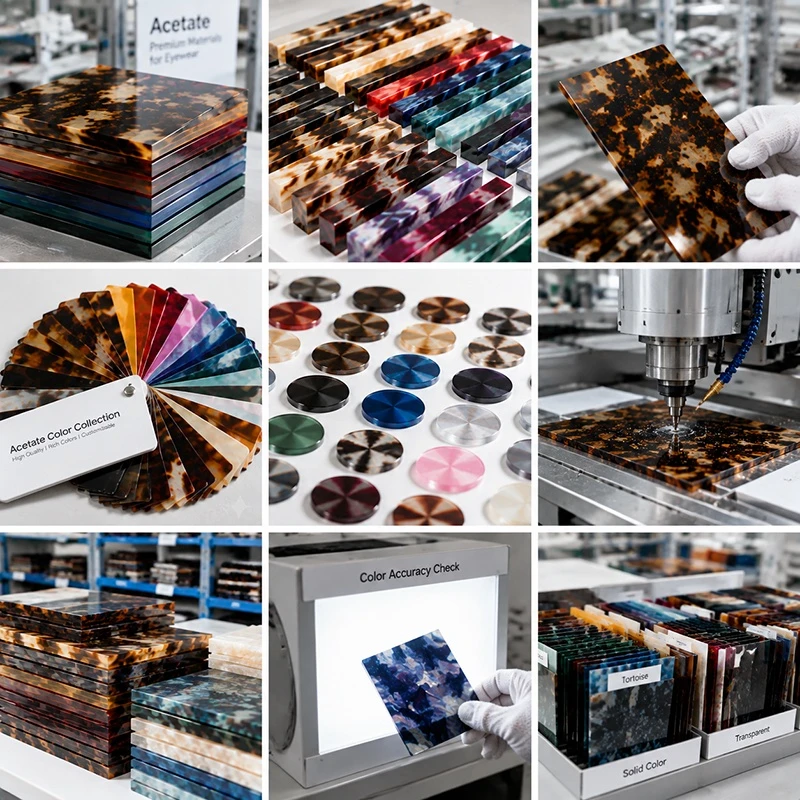
500+ Acetate Sheet Colors | xuanMou sunglasses Factory
We specialize in eyewear manufacturing with over 500 acetate sheet colors in stock - including tortoiseshell, translucent, solid, two-tone, marble and more patterns & shades.


Standard OEM Workflow

ODM Workflow
For customers without a finished design:

Key Factory Advantages for OEM/ODM Customers
1. Source Factory Direct Manufacturing
Customers communicate directly with the manufacturing team rather than adding unnecessary layers of intermediaries.
This can improve:
- Communication efficiency
- Product development speed
- Cost transparency
- Problem-solving efficiency
- Production control
2. Strong Acetate Manufacturing Capability
Acetate products require more than simply cutting a frame shape.
Professional processing involves:
Material Selection + CNC Processing + Manual Finishing + Polishing + Assembly + Alignment + QC
This integrated process helps maintain the appearance and consistency of premium acetate eyewear.
3. OEM & ODM Flexibility
Customers can choose between:
OEM - manufacture according to your design
and
ODM - develop products together with the factory
This makes the service suitable for both established brands and emerging eyewear businesses.
4. Rapid Sample Development
For suitable projects, the factory can support a quick sample-development cycle, with actual lead time depending on design complexity, tooling, material, and approval speed.
The objective is to reduce the time from:
Idea → Physical Sample → Market Testing
5. Flexible MOQ
Different product structures can be evaluated according to customer quantity requirements.
Flexible MOQ is particularly valuable for:
- Start-up brands
- New collections
- Market testing
- Small distributors
- Seasonal launches
6. Full Customization
Customization can cover:
- Frame Design
- Frame Color
- Acetate Pattern
- Logo
- Hardware
- Lens
- Packaging
- Accessories
- Box Set
This creates a genuine end-to-end private-label solution.
7. One-Stop Packaging
Instead of sourcing eyewear and packaging separately, customers can consolidate:
- Eyeglasses
- Sunglasses
- Cases
- Pouches
- Cleaning cloths
- Gift boxes
- Shopping bags
- Brand cards
into one coordinated supply chain.
This can reduce supplier-management complexity.
8. Multi-Level Quality Control
A structured QC process covers:
IQC → IPQC → FQC → OQC
rather than relying solely on inspection after production.
9. International B2B Support
The factory's service model can support overseas:
- Importers
- Distributors
- Optical retailers
- Eyewear brands
- Private-label companies
Cross-border e-commerce businesses
The communication process should be based on clear product specifications, approved samples, and documented requirements.
Recommended Customer Project Timeline
Actual lead times depend on product complexity, quantity, material availability, tooling, and customer approval speed, but a typical project can be organized into the following phases:
|
Stage |
Main Work |
Typical Status |
|
1 |
Inquiry & Requirement |
Project Brief |
|
2 |
Design Review |
Engineering |
|
3 |
Material Selection |
Material Approved |
|
4 |
Prototype |
Sample Development |
|
5 |
Sample Revision |
Customer Feedback |
|
6 |
Final Approval |
Golden Sample |
|
7 |
Quotation & PO |
Order Confirmed |
|
8 |
Material Preparation |
Production Ready |
|
9 |
Mass Production |
Manufacturing |
|
10 |
QC |
Inspection |
|
11 |
Packaging |
Finished Goods |
|
12 |
Shipment |
Delivery |
|
13 |
After-Sales |
Continuous Support |
For products that require molds, special materials, or complex construction, the schedule should be confirmed separately before the project starts.
Standard Documents Used Throughout the Process
A professional OEM/ODM project should maintain a complete documentation chain.
Development Documents
● Product Brief
● Design Drawing
● Technical Specification
● Material Specification
● Color Reference
● Sample Record
Order Documents
● Quotation
● Purchase Order
● Production Order
● Approved Sample
● Packaging Artwork
Quality Documents
● QC Standard
● Inspection Record
● Material Inspection Record
● Final Inspection Record
Shipping Documents
● Packing List
● Commercial Invoice
● Shipping Information
● Carton Marking
The exact documentation package depends on the customer's project and destination requirements.
The Core Philosophy of Our OEM/ODM Service
A professional eyewear manufacturer should not define OEM/ODM simply as "you give us a design, we manufacture it."
A complete OEM/ODM service should solve five fundamental customer problems:
A concise B2B positioning statement
From concept to finished eyewear, our OEM/ODM service provides one-stop support across design development, material selection, precision processing, hand finishing, private labeling, quality control, customized packaging, and international order fulfillment. By integrating product development and manufacturing under one supply chain, we help global eyewear brands, distributors, and optical retailers develop differentiated products with controlled quality, flexible customization, and efficient production management.